The machine delivers the average
A workflow for designers using language models — shown with Google AI Studio, but not tied to it
- Number
- Nr. 009
- Type
- writing
- Year
- File
- google-ai-studio_1_1.jpg
The first version of this article contained an example. I had asked a language model to write five calls to action for a sustainable fashion brand. It delivered: “Discover Our Ethically Crafted Styles”, “Explore Conscious Fashion Choices”, “Unveil Your Next Sustainable Wardrobe Staple”. Back then they stood in the text as a successful example. Today I read them as evidence for my thesis. These sentences aren’t wrong. They are the average of every sentence ever written about sustainable fashion. The machine delivers the middle, and design begins where you deliberately deviate from it.
Why the machine pulls towards the middle
A language model such as Gemini, which you can try out in Google AI Studio, calculates for each next word how probable it is. Without further instruction, it mostly picks one of the most probable continuations. That isn’t a flaw; it’s the blueprint. For a summary or a translation, the most probable answer is often the right one. For a tagline, a concept or a name, it is almost always the weakest, because everyone else gets it too.
There is a dial against this: temperature. In AI Studio you find it in the settings for each run. Higher values let the model stray further from the middle. That helps somewhat, but it doesn’t replace a stance: a model at high temperature isn’t bolder, just more random.
There is also a long-term effect. In 2024 Ilia Shumailov and colleagues showed in Nature that models trained on the output of other models lose their edges. The rare, unusual cases disappear; outputs become more uniform. The more text and images online come from machines, the stronger the pull of the middle.
A workflow in six steps
The following workflow works with AI Studio, but with any other language model too. It uses the machine for what it does well and keeps the decisions with the designer.
1. Your own brief first. Before you open the tool, write down in three sentences what you want and what you definitely don’t want. Whoever asks without a position of their own adopts the machine’s.
2. Order the average. Explicitly ask the model for the obvious answers — twenty of them. It sounds paradoxical but it’s the most useful step. In one minute you get the map of the obvious: everything your competitor gets too.
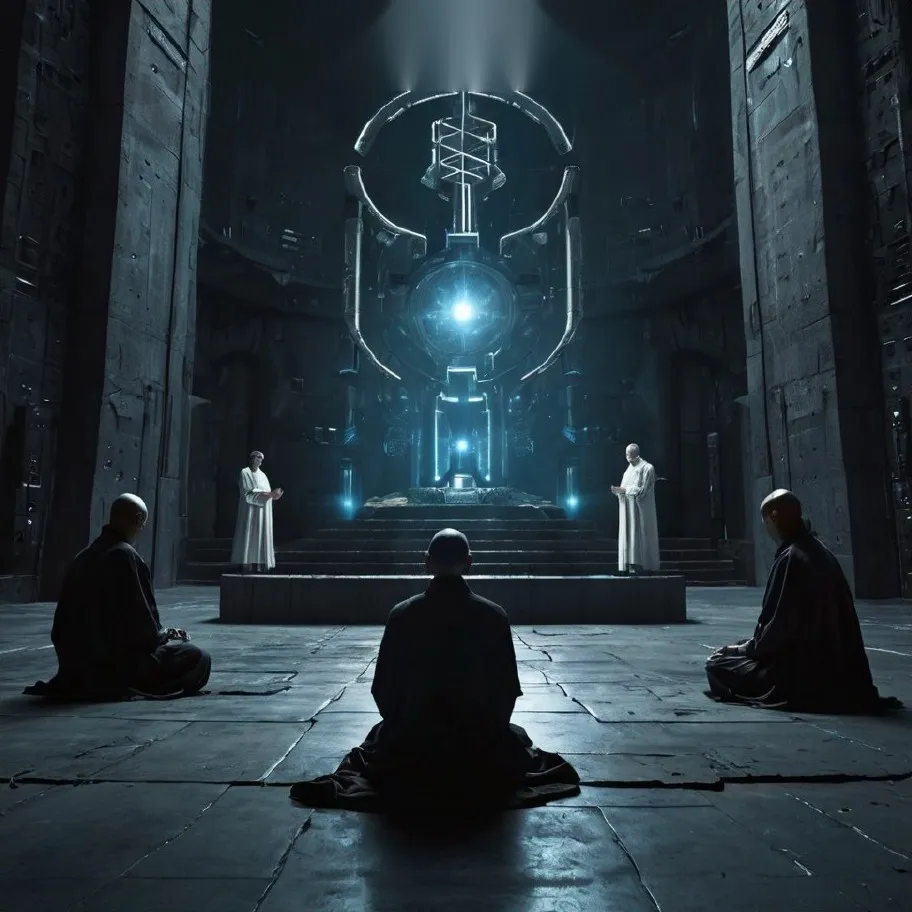 Fig. 1 — Monks before the Machine, from an AI image series in the archive: hall of columns, habits, a glowing sign. Not one element you haven’t seen before. This is the map of the obvious as a picture.
3. Use the map as an exclusion list. Whatever is on the list has already been thought. Strike it for your own work. What remains is the space worth searching.
4. Ask against the middle. Now the model can help — but with constraints: a tagline of three words at most, without adjectives. A name taken from another industry. A concept that claims the opposite of the list. Constraints push the model further from the average than any temperature.
5. Shift by three percent, by hand. From everything that has emerged, pick one candidate and change it yourself. Swap a word, drop one, double one. That is the work the machine can’t take over, because it has no intention. It can generate a deviation but can’t decide which one is meant.
6. Disclose and file. Note which parts were made with the help of a model and save the prompts that worked well. That’s no formality. Clients have a right to know where an idea comes from, and you only learn from what you can look up again.
What the machine is really good for
This scepticism applies to generating ideas. In other parts of the work, language models are a real relief — precisely because they know the middle well. They summarise long interview transcripts. They translate and adapt texts for other audiences. They structure feedback. They write small programs for prototypes. They check whether a text misuses a technical term. Wherever the expected is the right thing, the machine saves time you need for the deviation.
Virgil Abloh advised designers to change an existing thing by a few percent instead of reinventing it. With language models, that advice takes on a new meaning. The existing is no longer only what lies around in the world but also what the machine delivers at the push of a button. The three percent remain yours.
On your next project, ask the machine for the worst it has first. Then you know where not to look.