New meanings don’t come from the market
Roberto Verganti’s Design-Driven Innovation, read closely and against the grain
- Number
- Nr. 010
- Type
- writing
- Year
- File
- DDI.mov
When the Swatch launched in Zurich in 1983, it was no technical sensation. Quartz watches had existed for more than ten years, and Japanese competitors made them more cheaply. What was new was something else: the Swatch was no longer a watch you buy once in a lifetime and pass on. It was an accessory you pick to match your jumper, collect and change. The function stayed the same. The meaning tipped. In 2009 Roberto Verganti built a whole book on this observation, and I consider it one of the most important books on design ever published by a business press. That is exactly why it is worth reading against the grain too.
Three strategies, one overlooked
Verganti distinguishes three ways in which companies produce something new. Market pull: you ask users what they need and improve the product step by step. Technology push: a technical leap enables new performance. And a third, which he calls design-driven innovation: the company proposes a new meaning nobody asked for.
Most of his examples come from Italy, where he teaches at the Politecnico di Milano. With its Family Follows Fiction collection, Alessi turned household items into objects of affection — Alessandro Mendini’s corkscrew Anna G., for instance, a figure with a face and raised arms. With its Metamorfosi line, Artemide stopped selling lamps and started selling light that changes your mood. In 2006 Nintendo’s Wii turned video games, until then mostly played by young men in dark rooms, into exercise for the whole family in the living room.
 Fig. 1 — Alessandro Mendini’s Anna G. corkscrew for Alessi. It opens bottles like any other; what’s new is that you like it.
None of these products came from market research. Nobody in a survey would have said they wanted a corkscrew that looks like a person. Verganti’s central sentence, roughly: people buy things not only for what they do but for what they mean. And meanings can’t be asked for, because people only recognise them once they stand in front of them.
The laboratory of meanings
The strongest part of the book is not the thesis but the description of how such meanings come about. Verganti contradicts the image of the flash of genius. In his analysis, new meanings come from a network he calls the design discourse: designers, artists, architects, researchers, suppliers, curators, magazines. These interpreters are already busy thinking about how people might live. Companies that innovate radically listen to them, develop a vision of their own and feed it back into the discourse through exhibitions, books and concept objects before the product reaches the shop.
He describes three activities: listening, interpreting, addressing. It sounds like consultancy vocabulary but is precise. Listening means deliberately seeking out people outside your own industry who think about the same life situation. Interpreting means developing a position of your own from these voices instead of adopting the loudest. Addressing means preparing the ground so that a surprising product isn’t rejected as merely strange.
Anyone working in design recognises their own everyday life in this. The furniture fair in Milan, the Biennale, the art school, the magazine: these are not side shows of the industry but its research lab.
When technology uncovers a meaning
Verganti doesn’t separate meaning and technology as neatly as the three strategies suggest. The strongest cases in his book are those where the two come together. He calls them technology epiphanies: an existing technology is used in a way that uncovers a meaning that lay dormant in it.
The Wii is the clearest example. The motion sensors in its controllers were not Nintendo’s invention; similar components had long been in airbags and laptops. At the same time, Sony and Microsoft were racing for graphics performance — that is, for the meaning video games already had: immersing ever deeper in a virtual world. Nintendo accepted weaker graphics and used the sensor to offer the opposite: movement in the real world, in front of the sofa, with grandma.
 Fig. 2 — The Wii: white, small, rounded. It doesn’t look like a high-performance machine but like a device you leave standing in the living room.
The iPod was similar. Portable MP3 players existed before 2001, and music compression was well known. Apple combined device, software and later a shop into a system in which you collect, organise and carry your own music. The player became a personal library. The technology was the condition, not the innovation.
For designers this is the book’s most important lesson. A new technology is a question, not an answer. Whoever uses it only to make the existing faster gives it away to competitors who can do the same. Whoever asks which meaning it makes possible sometimes finds a product nobody can copy for ten years.
What speaks against the book
I consider three objections justified.
First: the book counts the winners. All the examples are successes. How many companies proposed a new meaning nobody wanted? Without the failures you can’t tell whether the strategy works or whether we are only looking at the survivors. Verganti acknowledges the risk, but his cases are selected, not counted.
Second: the myth of the visionary. The book approvingly quotes a former Apple manager saying Apple’s market research consisted of Steve Jobs looking in the mirror every morning. It is a good anecdote and a dangerous method. For a company with Jobs it may have worked. For most others it is a licence to mistake one’s own taste for a vision. Verganti actually means the opposite — systematic listening to interpreters. But the anecdote is what sticks.
Third: who belongs to the discourse? The network of interpreters as Verganti describes it is a network of the cultural elite: Milanese designers, curators, architecture professors. Ron Arad’s Bookworm shelf for Kartell is a fine example of a new meaning — the shelf as personal sculpture. But it also shows whom these meanings are made for. Meaning change that comes from below — from subcultures, the street, fan forums — barely appears in the book, even though streetwear has worked exactly this way for thirty years.
 Fig. 3 — Ron Arad’s Bookworm for Kartell: a shelf that, as a line on the wall, says more about who hung it than about how many books it holds.
The counter-position: Norman
The most interesting reply to Verganti came from Verganti himself, together with Donald Norman. Norman is the man who, with The Design of Everyday Things, turned user-centred design into doctrine. In 2014 the two co-wrote an article in Design Issues and reached a conclusion uncomfortable for Norman’s own school: user-centred research almost always leads to incremental improvements. Radical innovation comes from technological change or from meaning change, not from observing users.
Norman didn’t abandon user research. The two simply say what it is good for: climbing a hill better, not finding a new one. For practice I find this the most useful reading of the whole subject. There is no fight between user-centredness and vision. There are two tools for two different tasks, and most companies use only one.
That has consequences for briefings. Whoever starts a project with interviews, personas and customer journeys has already decided to improve the existing meaning. That is often right. But it should be a conscious decision, not a reflex of the process. The question at the start is then not: what do users want? But: do we want to climb the hill better or look for another one? For the second task, users aren’t the first port of call; interpreters are, and after them your own stance.
Shifting meaning by three percent
This is where I meet Verganti, but not entirely. His examples are radical: the watch becomes an accessory, the console becomes family sport. My method, Readymade ± 3 %, works smaller. It assumes you don’t have to reinvent a thing to change its meaning. Often a slight shift within its tolerance is enough for it to say something else.
Look closely, and Verganti’s examples were often the same. The Swatch was a quartz watch, only in plastic, colourful and built to be made cheaply. Anna G. is a lever corkscrew of a kind that had existed for decades, only with a head and a dress. The radical meaning doesn’t come from a radical form but from a precise, small deviation from the familiar one. That makes the strategy more accessible than the book makes it sound. You don’t need a Milanese network to apply it. You need a familiar thing and the nerve to shift it by three percent.
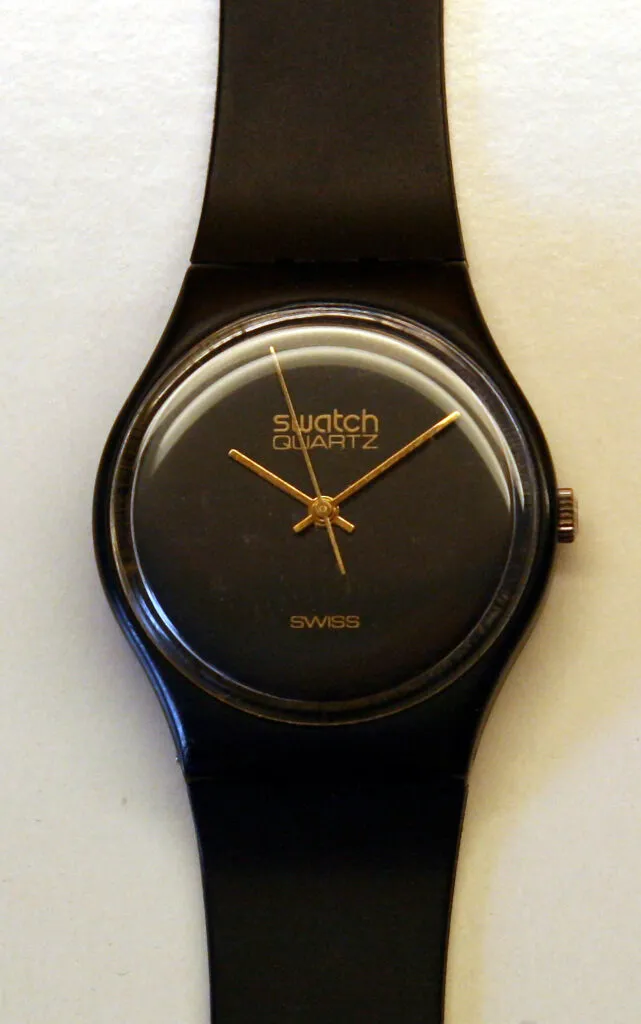 Fig. 4 — A Swatch, model GB101. Technically a cheap quartz watch, culturally a shift from a purchase for life to an accessory for the season.
Put an object you’ve owned for years in front of you and don’t ask how it could work better, but what it could mean instead.